1824–1898 - Who was Edward Rowcliffe?
Edward Lee Rowcliffe was a prominent Victorian landowner, lawyer, and benefactor whose influence shaped much of Hascombe’s 19th‑century character. In 1864, he purchased Hall Place Farm, an ancient timber‑framed farmhouse on Stovolds Hill, then a detached part of the parish. Over the following decades he transformed the estate, building a new residence known as Hall Place and steadily expanding his landholdings until they exceeded 1,000 acres by the 1890s. His success in the legal profession provided the means, but it was his deep personal commitment to the parish that left the most lasting mark.
Rowcliffe became one of Hascombe’s most generous supporters. He contributed significantly to the embellishment of St Peter’s Church in 1863, supported the construction of the village school house in 1867, and funded numerous improvements that enhanced daily life for local residents. His philanthropy was practical rather than showy, rooted in a belief that the wellbeing of the community should be improved through access to education, good land management, and most famously clean water.
His public service was recognised when he was appointed High Sheriff of Surrey in 1895, a role traditionally given to individuals of standing and integrity. When he died in 1898, the Rector, Vernon Musgrave, described him as “one of the truest friends and most generous benefactors that Hascombe has ever known… no farms being better cultivated or producing more satisfactory results; nothing was spent in show, while at the same time no outlay was spared to bring the land into the highest state of cultivation.”
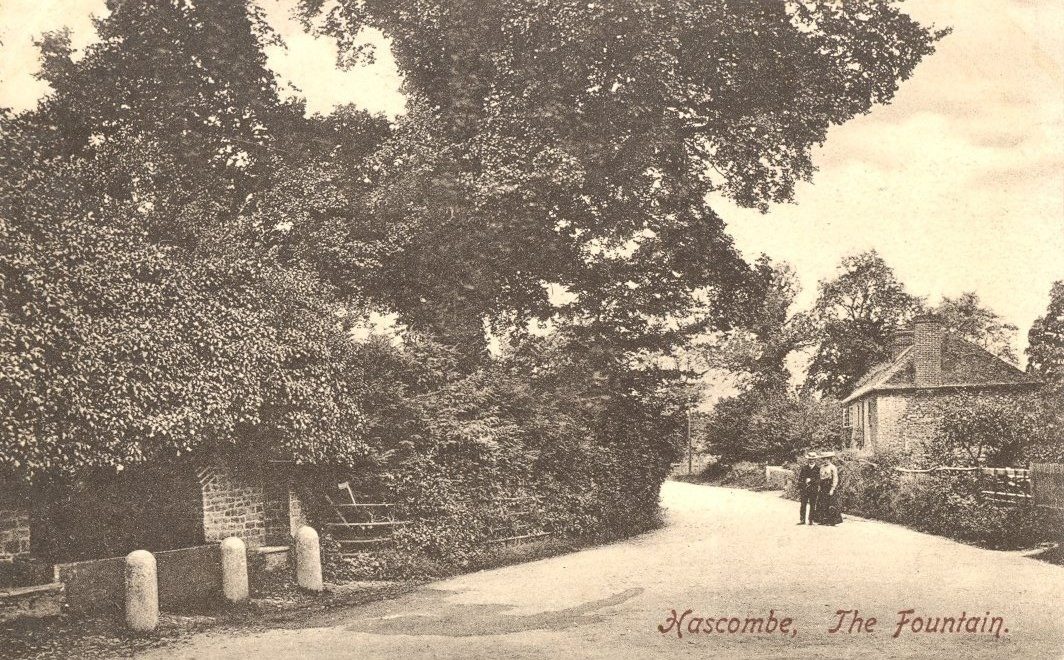
The Hascombe Fountain, built in 1877 in memory of his brother Henry, remains one of the clearest expressions of his values: a gift of clean, reliable water offered freely to all, at a time when safe drinking water was far from guaranteed.
What is the fountain made from?
The fountain is constructed from Bargate stone, a highly durable local sandstone with a warm honey colour caused by its iron‑oxide content. The stonework is laid in lime mortar, with voussoirs over the central arch. The water trough and bollards are made of granite.
“Whosoever will, let him take from the water of life freely”
The quotation carved into the arched stone is from the Book of Revelation chapter 22, verse 17: “Whosoever will, let him take from the water of life freely”.
This verse was chosen by Edward Lee Rowcliffe to reflect the purpose of the fountain: to provide clean, life‑giving water freely to all residents and travellers at a time when safe drinking water was far from guaranteed.
The inscription reinforces the fountain’s role as an act of public generosity and a symbol of community wellbeing. Its placement above the arch emphasises the idea that the water, like the sentiment, is offered without restriction, echoing the Victorian belief in improving public health through accessible, shared resources.